From powder to solid component – sintering
Sintering is a manufacturing process for producing metal or ceramic parts. Sintering technology as a manufacturing process for metal components is ideal for workpieces with special (usually simple) geometries, such as compact gears, pinions, bearings, or housings, which can be produced ready for installation, even with heat treatment.
The sintering process initially allows for shaping without heating the material. The metal powder is pressed into green compacts in dies at varying pressures, and then sintered at temperatures just below the melting point. During this process, the powder particles fuse together at their contact surfaces, giving the workpiece its dimensions and design. Thanks to a final calibration blow, the workpieces exhibit very high dimensional accuracy.
Sintering is an effective, environmentally friendly, and economical process, especially for high-volume production involving a wide variety of metals.
Manufacturing Processes
Advantages of Sintering
The sintering manufacturing process has several advantages.
- Sintering allows for the combination of raw materials that would otherwise be very difficult or impossible to combine into a new material.
- High dimensional and shape accuracy is achieved, so that post-processing is minimal or completely eliminated.
- Furthermore, the material is utilized optimally, resulting in minimal waste.
Use of Sintered Products
Sintered products are found in various industrial sectors. They are used, for example, in power electronic devices such as switching power supplies, filters, or antennas. They are also found in components such as cutting ceramics, electro-porcelain, or ceramic magnets. Sintered parts are found in large series, especially in the automotive industry, for example, in the form of components for engines and transmissions, as well as tool parts or indexable inserts made of hard metals. Dental technology uses sintering to produce ceramic teeth and veneers.
The development and optimization of new metal powders is constantly expanding the areas of application for sintered products.
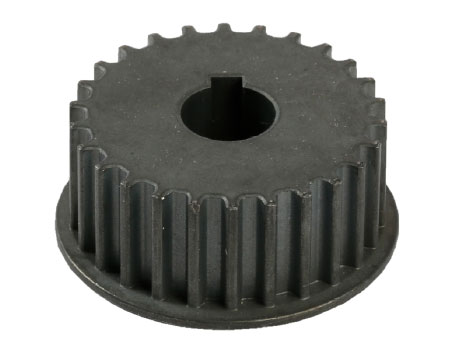
Toothed belt pulley
Size: 43x43x20 mm
Weight: 127 g
Material: FC0208

Locking bow
Size: 60x15x10 mm
Weight: 6 g
Material: Sint C-11

Toothed wheel
Size: 6x5x2 mm
Weight: 0,2 g
Material: CZ-3000

Piston
Size: Ø50x14,5 mm
Weight: 140 g
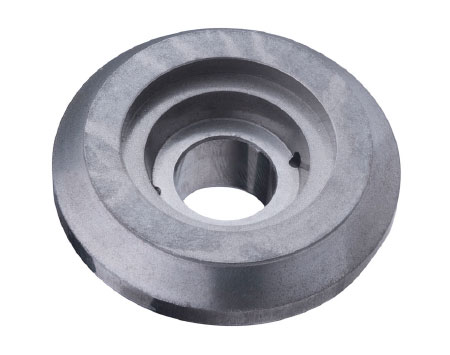
Guide disk
Size: Ø52x24,2 mm
Weight: 186.6 g